If you're wondering when to start pumping breast milk, the simple answer for most moms is to wait until your baby is around 4-6 weeks old. I know, that might seem like a long time, but there's a really good reason for it.
Those first few weeks are a critical time for you and your baby to get in sync.
Why Waiting to Pump Is Often a Good Idea
Think of that first month as a delicate dance. Every time your baby latches and nurses, they're placing a direct "order" with your body, telling it exactly how much milk to make. It's the most natural and effective way to build a healthy, robust milk supply that’s perfectly matched to your baby's needs.
By letting your baby take the lead, you allow this amazing supply-and-demand system to get established. This helps you avoid common headaches like oversupply, which can lead to painfully full breasts and clogged ducts.
This time is also about learning your baby's unique hunger cues and mastering a comfortable latch without the added stress of a pumping schedule. It really helps build your confidence and sets the stage for a smoother breastfeeding journey down the road.

Laying a Strong Foundation First
Focusing just on nursing for the first few weeks helps solidify your breastfeeding relationship. Your body learns to respond to your baby, and honestly, your baby is way more efficient at getting milk out than any pump ever will be.
But let's be real—the journey isn't always a straight line. Sometimes, things like painful, cracked nipples can make you question everything.
One new mom, Jessica, told me she was on the verge of giving up on breastfeeding because the pain was just too much. Her lactation consultant suggested she try Moogco Silver Nursing Cups, often called silverettes. These little cups offer natural healing and relief without any creams or ointments. "The silverettes saved my breastfeeding journey," Jessica said. "They gave me the space to heal so I could keep going."
Jessica’s story is a great reminder that having the right support can change everything. So, while the 4-6 week guideline is a fantastic starting point for many, it’s not a one-size-fits-all rule. This guide is here to walk you through the different situations where starting to pump sooner might be exactly what you and your baby need.
And if you're reading this before your little one arrives, getting a head start on what to expect can be a huge help. You can learn more in our guide on preparing for breastfeeding before your baby arrives.
Protecting Your Supply in the First Few Weeks
Those first few weeks with a newborn are a whirlwind of magic, exhaustion, and learning. It’s also the critical window for establishing your milk supply. Think of it like your body and your baby learning a new dance together—the rhythm is set by your baby's needs, and the goal is to build a strong foundation for your entire breastfeeding journey.

Every time your baby nurses, they're placing a very specific order with your body for how much milk to make next time. It's a perfect supply-and-demand system, and your baby is the one leading the dance. Honestly, they are far more efficient at getting milk out than any machine, which is why letting them take the lead helps your supply match their appetite perfectly.
Top-rated pumps + accessories
Pumping made simpler
Take 20% off at checkout, applied automatically when you shop through this link.
Shop with MOM20 →Free US shipping over $100. Code applies automatically at checkout.
Why Direct Breastfeeding Is Key at First
Focusing on nursing directly in the beginning helps you and your baby get completely in sync. You'll start to recognize their unique hunger cues—the little head turns, lip smacking, or fists-to-mouth movements—long before they get frustrated and start to cry. It's also much easier to nail a comfortable, effective latch when you can concentrate on just the two of you, without juggling a pump schedule.
Jumping in with a pump too early, especially when it's not medically needed, can sometimes throw this delicate balance off. It might lead to an oversupply, which sounds great in theory but can be a real headache. Oversupply often means painful engorgement, clogged ducts, and a fussy baby who's struggling to handle a super-fast milk flow.
"Your baby is the driver of your milk supply! If your breastfeeding journey is off to a good start, your baby is likely much better at removing milk from your breast than even the best double electric pump."
While the "wait to pump" advice is solid, it's also true that many mothers are pumping earlier these days for all sorts of reasons. Recent survey data actually shows that in the U.S., 38% of mothers start pumping on the day of delivery, and 67% have used a pump by day three. You can read more about these early pumping practice trends from Liebert Pub. This just goes to show how different every journey is, often shaped by medical advice or plans to return to work.
When Nipple Pain Creates a Hurdle
Even with the best intentions, things like sore or cracked nipples can make direct breastfeeding feel almost unbearable. This is where getting the right support is everything—it can help you find a way to heal while still protecting your nursing relationship. It’s a common fear that can make you second-guess your supply, but remember that pain is just a signal to get help, not a sign you’re failing. If you are worried about how much milk you’re making, you might find our guide on the signs of low milk supply and how to boost your confidence really helpful.
Success Story: Overcoming Nipple Pain with Silverettes
Meet Maria, a new mom who was all-in on breastfeeding but found herself in excruciating pain just a few days after her daughter arrived. "My nipples were cracked and bleeding, and I dreaded every single feeding," she recalls. "I was crying, my baby was crying, and I was so close to giving up and switching to formula."
Her lactation consultant suggested she try Moogco Silver Nursing Cups. Skeptical but desperate, Maria gave them a shot. These natural silver cups, often called silverettes, are designed to soothe and heal sore nipples using the natural antimicrobial properties of silver.
"The relief was almost immediate," Maria says. "The silverettes created a protective barrier that stopped the friction from my nursing bra, and they helped my skin heal incredibly fast without any messy creams. Those little cups didn't just save my nipples; they saved my entire breastfeeding experience." Thanks to the healing power of her silverette cups, Maria was able to get back to nursing comfortably, building a strong supply and a beautiful bond with her baby.
When Life Calls for an Earlier Start to Pumping
That 4-to-6-week sweet spot for introducing a pump is a great rule of thumb, but let's be real—breastfeeding journeys rarely follow a perfect script. Sometimes, life throws a curveball, and you need to bring in your pump much sooner.
Think of it this way: your pump isn't a replacement for nursing, but a powerful teammate ready to step in when direct breastfeeding isn't an option or needs a little backup. Whether your baby needs extra care, you're working to build your supply, or you've decided to exclusively pump, this is your guide to starting with confidence.
This flowchart gives a quick visual on when pumping is a medical must-have versus when nursing first is the way to go.
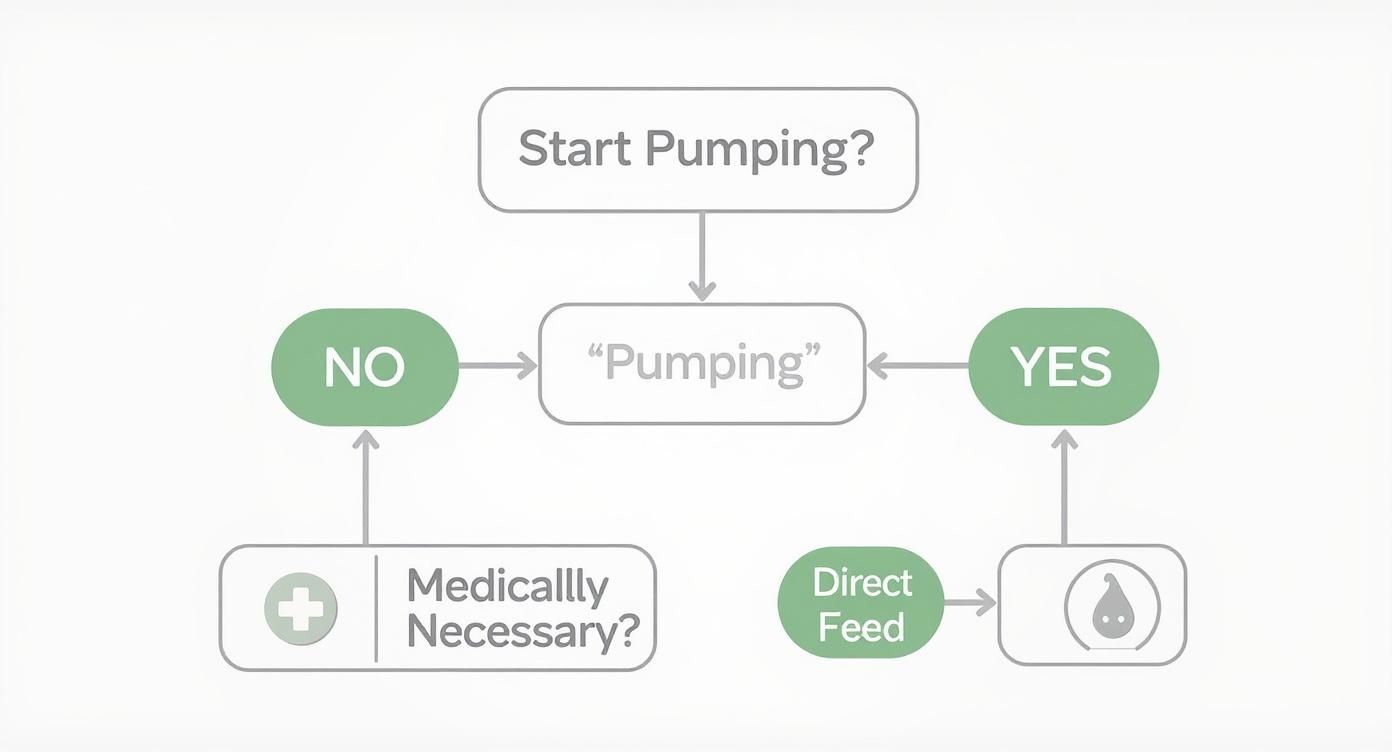
As you can see, when there's a medical reason, pumping becomes a crucial tool right away. Otherwise, putting your baby to the breast is the most natural way to get things flowing.
Pumping for a NICU or Preterm Baby
When a baby arrives early or needs time in the Neonatal Intensive Care Unit (NICU), your breast milk is liquid gold. It's more than just nutrition; it's a potent medicine packed with antibodies that are absolutely vital for their tiny, developing immune system.
In this situation, you’ll want to start pumping as soon as you possibly can, ideally within 1-6 hours after giving birth. That early stimulation is the single most important signal you can send your body to kickstart milk production, especially when your baby can't nurse directly.
Try to pump every 2-3 hours, day and night. The goal is 8-12 pumping sessions every 24 hours. It feels like a lot, but that consistency is what tells your body, "We have a baby to feed!" and builds the foundation for a strong supply.
Using a Pump to Boost a Low Supply
Feeling worried about your milk supply? You’re not alone. A fantastic technique to have up your sleeve is power pumping. It’s a clever way to mimic a baby’s cluster feeding sessions (those periods where they seem to be constantly nursing), which naturally signals your body to make more milk.
Here’s a popular one-hour power pumping routine to try once a day:
- Pump for 20 minutes
- Rest for 10 minutes
- Pump for another 10 minutes
- Rest for 10 minutes
- Pump for a final 10 minutes
It's definitely an intense hour, but this concentrated "demand" can work wonders, encouraging your supply to increase over the next few days.
When Latching Difficulties Arise
Oh, the frustration when latching just isn't clicking. Sometimes, for reasons like a tongue-tie, a high palate, or other challenges, a baby just can't get a good, effective latch. It can be incredibly disheartening for everyone.
If your baby isn't transferring milk well, it can affect both their weight gain and your supply. This is where pumping becomes essential. By pumping right after you try to nurse, you ensure your breasts are fully emptied. This protects your milk supply and ensures your baby gets all that precious milk from a bottle while you work with a lactation consultant to solve the latching puzzle.
A Mini-Guide for Exclusive Pumping
Choosing to exclusively pump is an incredible act of love and dedication. If this is your plan, your pumping journey begins on day one. To build and maintain a full milk supply without direct nursing, you have to become the "demand."
From the very beginning, you’ll need to pump every 2-3 hours around the clock. That means aiming for at least 8-12 sessions in a 24-hour period, especially for the first 12 weeks. This commitment is what builds a robust, long-term milk supply.
Juggling this schedule with a newborn is no small feat. It’s a huge commitment, particularly if you have more than one baby to care for. For more specific advice, take a look at our guide on tips and strategies for breastfeeding twins and multiples.
Pumping to Relieve Painful Engorgement
Sometime in that first week, your milk will "come in," and you might find yourself with painfully full, rock-hard breasts. This is engorgement, and it’s no joke. The instinct is to pump until they're empty and soft, but that can backfire by telling your body you need even more milk.
Instead, the key is to pump just for relief, not to empty. Just turn on the pump for 2-5 minutes—long enough to take the edge off the pain and soften the breast a bit. This provides immediate comfort without overstimulating production, allowing your supply to naturally regulate to your baby's actual needs.
Creating Your Return to Work Pumping Plan
Thinking about heading back to work after having a baby can bring up a lot of emotions. It's a huge transition! But mapping out a solid pumping plan ahead of time can make everything feel so much more manageable. The first big question is, when should you even start?
For most moms, the sweet spot is about 2 to 4 weeks before you're scheduled to go back.
Think of this as your low-pressure practice window. It gives you plenty of time to get the hang of your pump, let your baby get used to taking a bottle, and build a small freezer stash without feeling like you’re in a mad dash. The goal here is to build a comfortable routine, not a mountain of stress.
Building Your Starter Stash
So many new moms worry they need a freezer overflowing with milk before they can even think about going back to work. Here’s the good news: you probably need a lot less than you think. You're just aiming to have enough milk stored for your baby's first full day away from you, plus a little extra just in case.
To get started, just add one short pumping session into your day. The best time is often right after the first morning feed, usually somewhere between 5 a.m. and 9 a.m. Your milk-making hormone, prolactin, is at its peak in the early morning hours, so you’ll likely get the most milk then.
When you're also nursing full-time, it's totally normal to pump only 0.5 to 2 ounces total in a single session. Don't feel discouraged if you aren't filling up bottles right away. Every drop counts, and it's the consistency that builds your stash over time.
This gradual approach helps you store milk without accidentally signaling your body to go into oversupply mode. As your return date gets closer, you can have a caregiver offer your baby a bottle a few times a week. This helps them practice a new way of eating while you get more comfortable with your pump. If you're still figuring out your equipment, our guide on the best breast pumps for working moms can help you find the right fit.
Communicating with Your Employer
Having a chat with your boss before you return is one of the best things you can do for a smooth transition. Be clear and confident about what you'll need: a private, clean space to pump (that isn't a bathroom!) and the time to do it.
A good rule of thumb is to plan on pumping every 3-4 hours you're away from your baby. This schedule helps keep your milk supply steady and usually works out to two or three 15-20 minute breaks during a typical workday.
As you map everything out, you might find this helpful guide on timing maternity leave useful for handling the bigger logistics of your return.
Your Pumping Toolkit: Essential Gear and Tips for Success
Figuring out when to start pumping is half the battle. The other half? Making sure your sessions are comfortable, efficient, and actually work for you. Let's get your toolkit sorted so you can avoid common frustrations and make every drop count.
Think of it like getting the right running shoes—the perfect fit makes all the difference for comfort and performance.
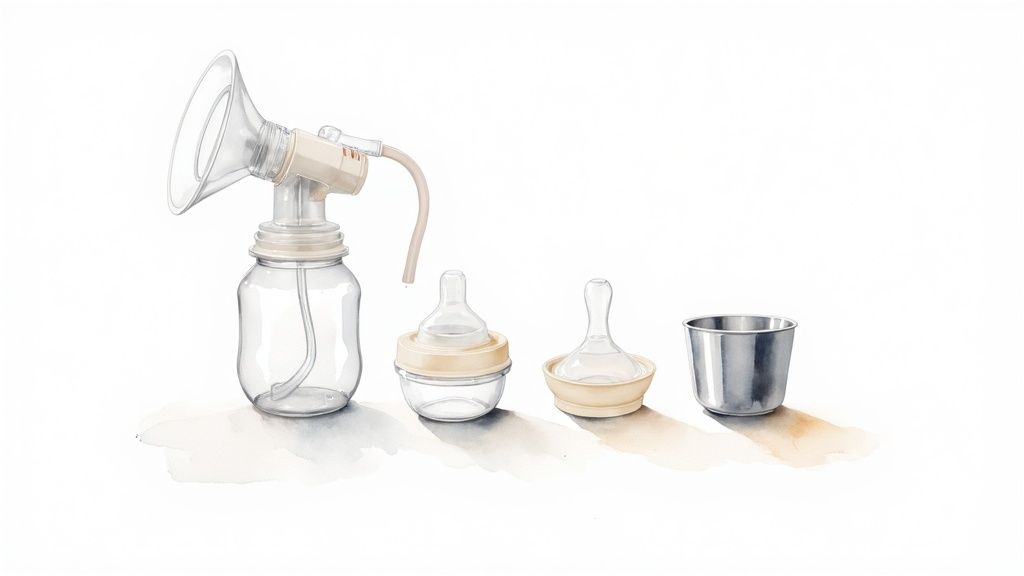
Nailing Your Pumping Setup
If there’s one thing to get right, it’s your flange size. This is hands-down the most critical piece of the puzzle. A flange that’s too big or too small won’t just be painful; it will leave milk behind, which can tell your body to start making less. If you feel any pinching, rubbing, or discomfort, it’s a big red flag that you need to re-measure.
Next up, a hands-free pumping bra. Seriously, this little piece of fabric is a lifesaver. It gives you the freedom to send a text, sip some water, or just zone out for a few minutes. It turns pumping from a chore into a much more manageable part of your routine.
Here are a few other simple tricks to make your sessions go smoothly:
- Warm Up First: A warm compress on your breasts for a few minutes before you start can really help get your milk flowing faster.
- Use Your Hands: Gently massaging your breasts while you pump (this is called "hands-on pumping") helps empty them more completely, which can boost your output.
- Think About Your Baby: It might sound cheesy, but looking at a photo or video of your little one can trigger the release of oxytocin—the "love hormone" that plays a huge role in letdown.
- Stay Squeaky Clean: Keeping your pump parts clean is non-negotiable for your baby’s health. We have a full breakdown in our guide on how to clean your breast pump the right way.
A Story of Healing: When Pumping Hurts
Sometimes, the biggest hurdle isn't the pump at all—it's the raw, physical discomfort of early breastfeeding. For so many moms, painful, cracked nipples can make them want to throw in the towel before they’ve even found their rhythm. This is exactly where Sarah found herself.
Sarah was determined to breastfeed, but severe nipple pain had her in tears with every single latch. She was feeling totally defeated and on the verge of giving up. Then, a friend told her about Moogco Silver Nursing Cups.
These little cups, often called silverettes, are crafted from 925 sterling silver and are designed to create the perfect healing environment. They use silver’s natural antimicrobial properties to soothe irritation and help repair damaged skin—all without messy creams or ointments. Sarah started wearing them between nursing sessions and pumping, and she felt a difference almost right away.
"The silverettes were a total game-changer," Sarah says. "They gave me immediate relief from the friction of my bra and clothes, and my nipples healed so much faster than I expected. They didn't just save my nipples; they saved my entire breastfeeding journey."
Sarah’s story is such a powerful reminder that with the right tools, you can push through even the toughest challenges. The initial discomfort doesn't have to be the end of your story. Tools like silverette cups can offer the comfort and healing needed to keep going and reach your personal breastfeeding goals.
You can learn more about these amazing silverette cups here.
Answering Your Top Pumping Questions
Once you get the hang of pumping, a whole new world of questions tends to pop up. Suddenly, you're wondering about session times, storage rules, and whether you're actually pumping enough. It can feel like a lot, but don't worry—these are the exact same things other moms wonder about. Let's walk through some of the most common questions together.
How Long Should I Pump For?
This is a classic! For most people, a solid 15-20 minute pumping session is the sweet spot. It’s a common myth that pumping longer equals more milk, but it's really about efficiency, not endurance.
Your goal is to pump until you see your milk flow slow down to a trickle, and then keep going for just another 2-5 minutes. That little extra time is a powerful signal to your body to keep up production. Pushing past the 30-minute mark rarely gets you much more milk and can leave you with sore, unhappy nipples. Instead, focus on triggering one or two "letdowns"—that tingly, pins-and-needles feeling when your milk really starts flowing.
One mom, Sarah, told us how cracked, painful nipples made her dread every single feeding. She almost gave up, but then she found Moogco Silver Nursing Cups (often called silverettes) and they completely changed her experience. "The silverettes were a lifesaver," she said. "They soothed the pain and let me heal, which meant I could keep breastfeeding and pumping for my baby." You can learn more about these amazing silverette cups here.
How Do I Store Breast Milk Safely?
Getting the hang of milk storage is all about keeping that liquid gold safe and sound for your little one. The easiest way to remember the basics for freshly expressed milk is the "rule of 4s." It's a simple, catchy guideline that makes life a lot easier.
- Room Temperature: Up to 4 hours.
- Refrigerator: Up to 4 days.
- Standard Freezer: Best quality for up to 6 months.
- Deep Freezer: Good for up to 12 months.
Always, always label your storage bags or bottles with the date and amount. Here's a pro tip: freeze your milk bags flat. Once they're frozen solid, you can line them up vertically like little books in a shoebox—it’s a total game-changer for freezer space! When you're ready to use it, thaw the milk in the fridge or under a stream of warm (not hot!) water. Just remember to never use a microwave; it nukes the good stuff and can create dangerous hot spots.
What if I’m Not Pumping Enough Milk?
This is easily the number one worry for pumping moms. Before you spiral, take a deep breath and remember this: the amount you pump is not a direct reflection of your actual milk supply. A baby is infinitely more efficient at getting milk out than any machine will ever be.
If you're also nursing full-time, pumping between 0.5 to 2 ounces total (from both sides combined) is completely normal. If you’re still worried, run through this quick mental checklist:
- Check Your Flange Fit: Is it comfortable? An ill-fitting flange is the most common culprit for low output and pain.
- Inspect Your Pump Parts: Tiny parts like valves and membranes wear out and can kill your pump's suction. Swap them out regularly!
- Are You Hydrated and Fed? Your body can't make milk out of thin air. Drink plenty of water and try not to skip meals.
Many moms find they get the most milk when they pump after the first morning feed, since that's when milk-making hormones are at their peak. If you've tried these things and still feel like something is off, that's a perfect time to call in an expert.
When Is It Time to Call a Lactation Consultant?
Please hear this: reaching out for help is a sign of strength. You don't have to figure this all out alone! An International Board Certified Lactation Consultant (IBCLC) is a trained professional who can provide personalized, hands-on support that makes all the difference.
Think about calling an IBCLC if you're dealing with any of these situations:
- It hurts to pump: Pumping should not be painful. Any real discomfort means something needs adjusting.
- You have ongoing worries about your supply: An IBCLC can help you create a realistic plan to boost production if it's truly needed.
- Your baby isn't gaining weight as expected: A consultant can help you get to the root of the problem, whether it's milk transfer or something else.
- You just need some reassurance: Honestly, sometimes you just need an expert to look you in the eye and tell you that you're doing a great job.
Getting support early on can keep small frustrations from turning into huge roadblocks, helping you enjoy the journey so much more.
At Moogco Baby, we’re here for you through every up and down of parenthood with essentials you can trust and guidance you can count on. Come explore our collections to find everything you need to heal, bond, and thrive. https://www.moogcobaby.com
Bring this guide home with 20% off.
Use code MOM20 for 20% off →
Frequently Asked Questions
Can I pump on one side while nursing on the other?
Yes, you can, and some moms find this helpful for building a freezer stash. However, it's best to wait until your supply is well established, usually around 6 weeks, to avoid creating an oversupply. If you do try this, pay attention to how your body responds and watch for signs of engorgement or clogged ducts.
Will pumping hurt if I already have sore nipples?
Pumping can be uncomfortable if your nipples are already sore or cracked, but it shouldn't be as painful as direct nursing if you use the right flange size and suction settings. Start with the lowest comfortable suction and make sure your nipple isn't rubbing against the tunnel. Many moms find that silver nursing cups help heal nipple pain quickly so both nursing and pumping become more comfortable.
Should I pump after every feeding to increase my supply?
Not necessarily. If your supply is meeting your baby's needs, pumping after every feeding can lead to oversupply and discomfort. However, if you have a genuine low supply or are building a stash for returning to work, adding one or two pumping sessions after nursing can help. Always start with just one session and see how your body responds.
Is it normal for pumping output to be lower than what my baby drinks?
Absolutely, and this is super common. Your baby is much more efficient at removing milk than any pump, so what you pump is not a true measure of your supply. Many moms pump 2 to 4 ounces total in a session but have babies who nurse much more effectively. If your baby is gaining weight and has plenty of wet diapers, your supply is likely just fine.
Can I start pumping before my milk comes in?
Yes, you can, especially if you have a NICU baby or a medical reason. Pumping colostrum in the first few days can be collected and given to your baby, and the stimulation helps signal your body to produce milk. Even tiny amounts of colostrum are incredibly valuable for your newborn.
What time of day is best for pumping?
Most moms find that early morning, typically between 2 a.m. and 6 a.m., is when their milk supply is highest due to elevated prolactin levels. If you're adding a pumping session to build a stash, try pumping right after your first morning feed or on the opposite breast while baby nurses. Listen to your body and find what works with your routine.
Do I need to sterilize my pump parts after every use?
For healthy, full-term babies, you don't need to sterilize after every session. Washing pump parts with hot, soapy water and letting them air dry is usually enough for daily use. However, sterilizing once a day or every few days, and always after the first use, is a good practice. Check with your pediatrician if your baby is premature or has a compromised immune system.
How do I know if I'm using the right size breast shield?
The right breast shield, or flange, should allow your nipple to move freely in the tunnel without rubbing or pulling in too much areola. If you notice pain, your nipple turning white, or very little milk coming out, your flange may be the wrong size. Most pumps come with multiple sizes, and getting a proper fit makes a huge difference in comfort and output.
From Moogco Studio
Printable and personalized nursery essentials. Designed by moms for moms.


About the Editor
Eda Ulger is the editor at Moogco Baby and a mom of two. She curates and edits our guides so every piece is honest, practical, and genuinely helpful for the early days of motherhood.