


So, you're trying to figure out where your new baby will sleep. It’s one of the first big decisions you’ll make, and it often boils down to a crib versus a bassinet.
Think of it like this: A bassinet is all about short-term convenience. It's small, portable, and perfect for keeping your little one right by your side for those first few months. A crib, on the other hand, is a long-term investment that will see them through to their toddler years. The right choice really just depends on your living space, budget, and day-to-day life.
Your First Big Decision: Crib vs. Bassinet Explained
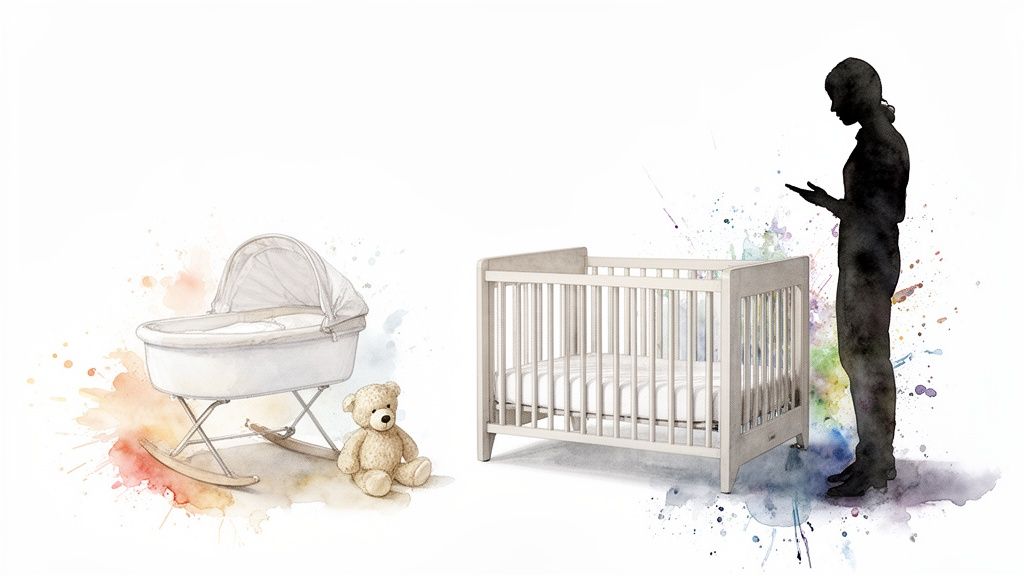

Welcome to one of the most exciting parts of nesting! Choosing your baby's first bed is about so much more than just furniture—it's about creating a safe, cozy, and convenient space for them to sleep. Getting a handle on the key differences between a crib and a bassinet will make this decision feel much less overwhelming.
Curated picks for the room you'll live in
Build a calm, beautiful nursery
Take 20% off at checkout, applied automatically when you shop through this link.
Shop with BABY20 →Free US shipping over $100. Code applies automatically at checkout.
It's no surprise that bassinets are becoming incredibly popular. The global market is expected to hit nearly $2.8 billion by 2033, and a lot of that growth comes from parents wanting to keep their newborns close for safer sleep and easier middle-of-the-night feedings.
For many new moms, those early weeks are an absolute whirlwind of feeding and healing. One mom, Sarah, told us that breastfeeding was so painful she almost gave up. What turned things around for her was a simple combination: a bedside bassinet and Moogco Silver Nursing Cups. Having the bassinet right there made night feeds so much easier to manage, while the natural healing power of the silver nursing cups soothed her soreness without any messy creams. This little setup gave her the confidence to stick with her breastfeeding goals.
Crib vs. Bassinet At A Glance
To really see how they stack up, let's put them side-by-side. This table gives you a quick snapshot of the most important things to consider when picking between a crib and a bassinet.
| Feature | Bassinet | Crib |
|---|---|---|
| Typical Use | Birth to 4-6 months | Birth to 2-3 years |
| Size & Footprint | Small, compact | Large, requires more space |
| Portability | High (easy to move) | Low (stationary) |
| Cost | Generally lower upfront | Higher upfront investment |
| Best For | Room-sharing, small spaces | Long-term use, dedicated nursery |
This is just a starting point, of course. For a much deeper dive into all the sleep options and other nursery essentials, be sure to check out our guide to the best baby furniture.
The Bassinet: A Cozy Start for Your Newborn

Think of a bassinet as a warm, gentle welcome for your newborn. That small, snug space is designed to feel secure, a lot like the close comfort of the womb. For a tiny baby adjusting to a great big world, this cozy environment can make all the difference in helping them settle and sleep.
The real win for parents, though? Pure convenience. A bassinet's small footprint and portability make it perfect for room-sharing, something the American Academy of Pediatrics (AAP) recommends for at least the first six months. Having your baby right by your side makes those middle-of-the-night feedings and diaper changes so much easier.
Many parents swear by bedside sleepers—a special type of bassinet that snugs up safely against your bed, often with a drop-down side. It's a total game-changer. You can soothe, feed, and check on your baby without ever having to leave your own bed, which feels like a superpower during those first exhausting weeks.
Maximizing Convenience and Comfort
Keeping your baby close isn't just about making your life easier; it brings incredible peace of mind. A quick glance or a gentle touch is all it takes to reassure yourself that they're okay, letting you get back to sleep faster.
This is a huge benefit for breastfeeding moms. When your baby is just an arm's reach away, night nursing feels less like a major disruption. That easy access can make a real impact on maintaining your milk supply and squeezing in every precious minute of rest.
For a new mom, Chloe, this was a lifesaver. She was committed to breastfeeding but was struggling with soreness and exhaustion. Her solution? A bedside bassinet combined with Moogco Silver Nursing Cups. Keeping her baby close made night feeds manageable, and the silver nursing cups provided natural, soothing relief. This simple setup helped her get through the tough early days and breastfeed with confidence.
Understanding the Bassinet's Lifespan
As wonderful as they are, bassinets are a short-term solution. Their use isn't determined by the calendar, but by your baby's own growth and development. You've got to watch for the signs that it's time to move on.
Here are the key milestones that mean it's time to transition to a crib:
- Rolling Over: The moment your baby can roll from back to front, a bassinet is no longer safe. Its shallow sides become a fall risk.
- Pushing Up: If your little one is starting to push up on their hands and knees, they're strong enough to potentially tip or pull themselves out.
- Weight Limits: Pay close attention to the manufacturer's weight limit, which is usually between 15 and 20 pounds. This is a hard-and-fast safety rule.
A bassinet is truly meant for the newborn phase, typically from birth up to about 4 to 6 months old. It’s a temporary sleep space for when your baby isn't mobile yet.
Knowing these limits from the start helps you plan ahead. As your baby gets bigger, their sleep environment needs to evolve, too. For a deeper dive into what to expect, check out our guide on navigating a newborn sleep schedule by week. Thinking about the next step now ensures the move from bassinet to crib is smooth and safe when the time comes.
The Crib: A Long-Term Investment in Safe Sleep
While a bassinet offers that cozy, right-by-your-bed convenience for the first few months, the crib is the undisputed long-term champion of the nursery. It’s best to think of a crib not just as a piece of furniture, but as a lasting investment in your child’s safety and comfort for years to come.
Unlike a bassinet, which your baby will outgrow in a flash, a crib is built to last from the newborn stage all the way through toddlerhood. This longevity is a huge draw for parents who are trying to plan ahead. With a crib, you're setting up a consistent, safe sleep space that will be there from day one.
Growing With Your Child: Convertible Cribs
One of the smartest choices for modern parents is the convertible crib. These multi-talented designs transform as your child grows, typically converting from a standard crib to a toddler bed, a daybed, and sometimes even a full-size bed frame. It’s a brilliant way to avoid buying new furniture every couple of years.
There's a good reason these multi-use cribs are so popular. In fact, convertible cribs are projected to capture a 33.2% revenue share in 2025 within a baby cribs market valued at $1.86 billion. Why? Savvy parents understand that a single, smart purchase can save them 30-40% on future furniture costs down the line. You can explore more about these market trends in detailed baby cribs market reports.
Starting with a convertible crib means your child has a familiar sleep environment as they grow, which can make those big transitions—like moving to a "big kid bed"—feel a lot less scary for everyone.
Non-Negotiable Safety Standards
Whether you start with a crib or a bassinet, safety is always the top priority. The U.S. Consumer Product Safety Commission (CPSC) has incredibly strict standards for cribs to make sure they are the safest possible place for a baby to sleep.
Here are the key safety features that are absolutely non-negotiable:
- Fixed Sides: You won't find drop-side cribs anymore—they were banned back in 2011 due to serious safety risks. All modern cribs must have stationary sides.
- Proper Slat Spacing: The gap between the slats can't be more than 2 3/8 inches. That's about the width of a soda can, and it's designed to prevent a baby's head from getting trapped.
- Strong Mattress Support: The base that holds the mattress needs to be tough and securely attached.
- No Cutouts: The headboard and footboard should be solid pieces, without any decorative cutouts that could potentially trap a little one.
A fantastic feature to look for is an adjustable mattress height. You can start with the mattress at its highest setting, which makes it so much easier to lift a tiny newborn in and out. As your baby starts to sit or pull themselves up, you simply lower it to keep them from climbing out.
Making sure your crib meets these CPSC standards offers priceless peace of mind. Of course, the mattress you choose is just as important. For a deep dive on that, check out our guide on finding the best crib mattress for newborns.
Ultimately, a crib provides a secure, regulated, and long-lasting sleep space. While it does require a bigger upfront investment and more floor space, its incredible lifespan and unwavering safety features make it a cornerstone of the nursery.
How To Choose The Right Sleep Space For Your Family
Okay, let's get real. The crib vs. bassinet decision can feel monumental, but it really just comes down to what works for your family and your home. Forget a generic pro/con list; the best choice becomes obvious when you think about your actual life.
Are you working with a cozy city apartment? Planning to breastfeed around the clock? Or is that dream nursery already painted and just waiting for the main event? Your honest answers to these questions are what will guide you to the perfect pick.
Scenario Based Decision Making
Let's walk through a few common situations new parents find themselves in. See which one sounds most like you.
If you live in a small apartment or plan to room-share for 6+ months:
A bassinet is your best friend. Seriously. Its tiny footprint is a game-changer when every square foot counts. You can snug it right up to your bed, keeping your baby close for those middle-of-the-night checks without tripping over a bulky piece of furniture. It makes following safe room-sharing guidelines a total breeze.
If you have a dedicated nursery ready to go from day one:
Go for the crib. Why not start your baby in their permanent sleep space from the get-go? It helps build a consistent routine right away and saves you from having to manage the "big kid bed" transition just a few months down the line.
If you plan to breastfeed frequently through the night:
A bedside bassinet can be an absolute lifesaver. Being able to scoop up your baby for a feed without even swinging your legs out of bed? It’s a game-changer for getting a little more rest. Those frequent wake-ups feel so much more manageable when you minimize the disruption.
This simple decision tree can help you visualize which path aligns with your main priority, whether that's saving space and money or maximizing convenience.
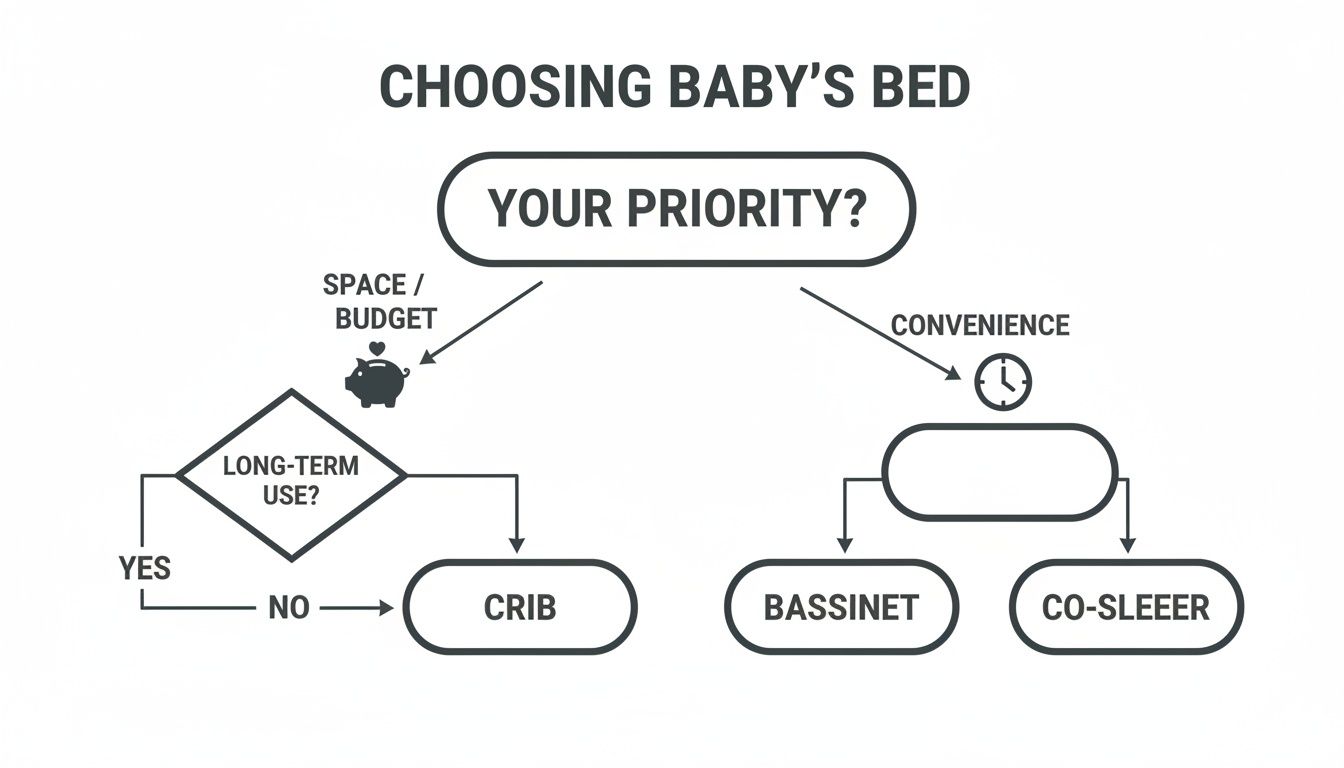
The flowchart helps cut through the noise by connecting your biggest priority—like your budget or the need for convenience—straight to the sleep solution that makes the most sense.
A Detailed Comparison Crib vs Bassinet
To really drill down into the details, sometimes seeing it all laid out helps. Here’s a quick-glance table breaking down the key differences that matter most.
| Consideration | Bassinet | Crib | Best For... |
|---|---|---|---|
| Lifespan | 3-6 months (or until baby rolls over/pushes up) | 2-3 years (or until they can climb out) | Parents looking for long-term value. |
| Size & Footprint | Small and compact | Larger, requires significant space | Families with limited space or room-sharing. |
| Portability | Highly portable, easy to move between rooms | Stationary, a permanent fixture in the nursery | Parents who want baby to nap in different rooms. |
| Cost | $50 - $250+ | $150 - $1,000+ | Budget-conscious parents needing a short-term solution. |
| Convenience | Excellent for newborns, especially bedside models | Less convenient for nighttime feeds in another room | Breastfeeding moms or post-C-section recovery. |
This table should help clarify which option ticks the most important boxes for your family’s specific needs.
Considering Your Budget And Future Plans
Money and long-term family plans definitely play a big part in this. It's smart to think a few steps ahead of the newborn fog.
- Upfront Cost vs. Long-Term Value: A bassinet is easier on the wallet initially, but a crib is where you get the most bang for your buck since it lasts for years. A convertible crib stretches that value even further, growing with your child from toddler bed to full-size bed.
- Planning for More Children: If you're hoping for another baby in a few years, a sturdy, well-made crib is a fantastic investment. It can easily be passed down, making that higher upfront cost feel much more reasonable in the long run.
The biggest differentiator comes down to this: A bassinet offers unparalleled convenience and portability for the first few months, while a crib provides lasting value and a consistent, safe sleep space for years.
While you're setting up the sleep space, don't forget the air your baby is breathing. A clean environment is so important. This guide to indoor air quality solutions has some great, practical tips.
The Rise Of Smart Sleep Technology
Tech has officially entered the nursery. The smart bassinet market is on track to hit $250 million in 2025, and it’s easy to see why parents are drawn in. These high-tech sleep spaces boast features like AI-powered cry detection, automatic rocking, and white noise, all designed to soothe a fussy baby back to sleep.
It makes perfect sense when you consider that nearly 70% of millennial parents say they look for both sustainability and smart technology in the products they buy. For a family that loves data and a little extra reassurance, a smart crib or bassinet can feel like a worthy splurge.
Ultimately, there is no single "right" answer here. Choosing a crib or bassinet is about finding the best fit for your family, your home, and your peace of mind. Once you've locked in this big decision, you can get to the fun stuff! We've got a great checklist to help with that in your guide to baby nursery must-haves.
One Mom's Story: How Moogco Helped Her Breastfeed in Peace

It’s one thing to read a product manual, but it’s another to hear a story from a parent who’s been in the trenches. Take Jenna, a new mom whose decision between a crib or bassinet for her newborn was just one tiny part of a much bigger, more daunting challenge: breastfeeding.
Jenna was determined to breastfeed, but the reality hit her hard. The first few weeks were an absolute blur of constant cluster feeds and zero sleep. Like so many new mothers, she was dealing with painfully sore, cracked nipples that made every single latch a toe-curling experience. She was physically and emotionally drained, and honestly, on the verge of giving up.
The dread she felt before each feeding was creating a vicious cycle of stress, which she knew wasn't helping her or her baby. She needed a real solution, not another cream that offered a minute of relief. A friend finally mentioned she should try Moogco Silver Nursing Cups.
Finally Finding Comfort and Confidence
Jenna was skeptical, but at that point, she was willing to try anything. The silver nursing cups turned out to be a game-changer. They were nothing like the messy creams she'd been using, which always had to be wiped off before a feed. These were just simple, natural, and they worked. She wore them between feedings, and the pure silver started soothing her skin and helping it heal.
In just a couple of days, the difference was night and day. The intense pain started to subside, and the soreness faded. It wasn't just a physical relief; it was mental. It gave her the space to finally take a deep breath and reconnect with her baby, without that cloud of pain hanging over her.
"The Moogco Silver Nursing Cups honestly saved my breastfeeding journey. I was in so much pain that I was ready to switch to formula. They provided such fast, natural relief that I could finally relax and enjoy those precious moments with my son."
With the feeding pain managed, Jenna could finally appreciate her other newborn choices—like the bedside bassinet she’d picked out. Having her son right there within arm's reach for those frequent night feedings suddenly felt like the smartest decision she’d ever made.
The Perfect Pair for Newborn Life
It turned out that her bedside bassinet and the Moogco Silver Nursing Cups were the perfect team. The bassinet made nighttime feeds way less disruptive, keeping her baby close and safe. Meanwhile, the silver nursing cups made sure she was comfortable and pain-free for every one of those feeds.
This combination completely transformed her newborn experience. She wasn't just surviving anymore; she was actually enjoying it. Her story is such a great reminder that having the right tools can make or break your parenting goals.
For any parent wrestling with the crib or bassinet for a newborn decision, Jenna’s journey shows how one choice can ripple out and affect everything else, including feeding. By setting yourself up for comfort and convenience, you give yourself the best shot at building that incredible bond. You can check out the same Moogco Silver Nursing Cups that made all the difference for Jenna.
Your Essential Safe Sleep Shopping Checklist
Alright, feeling ready to actually buy your baby's first bed? Let's cut through all the marketing fluff and get down to what really matters: safety. I've broken this down into two simple checklists—one for bassinets and one for cribs—so you can feel totally confident when you're comparing models.
Think of this as your final quality-control check before making one of the most important purchases for your new arrival. It's all about making sure that little one has a secure place to rest, because that’s the starting point for healthy sleep.
The Bassinet Safety Checklist
When you're sizing up bassinets, your two biggest watchwords are stability and breathability. A wobbly frame is an instant "no," and so is any design that looks like it could tip over if you bumped into it in the middle of the night.
Here are the absolute non-negotiables to look for:
- A Wide, Stable Base: Give it a gentle push. Does it feel solid? It shouldn't rock or wobble. This is hands-down the most important feature for preventing accidental tipping.
- Breathable Mesh Walls: Look for designs with mesh sides. This allows for maximum airflow and reduces the risk of suffocation if your baby somehow scoots over and presses their face against the side.
- A Firm, Flat Mattress: The mattress should be thin, firm, and fit perfectly inside the bassinet frame. There should be absolutely no gaps around the edges where a baby could get stuck.
- JPMA Certification: Keep an eye out for the Juvenile Products Manufacturers Association (JPMA) seal. This little sticker is a big deal—it means the product was independently tested to meet high safety standards.
Here's the bottom line: a bassinet is a temporary sleep spot for an infant who isn't mobile yet. The second you see your baby showing signs of rolling over or pushing up on their hands and knees, it’s graduation day. Time to move to the crib.
The Crib Safety Checklist
A crib is a long-term investment, so you're looking for a durable, fortress-like sleep space that meets today's strict federal safety rules. A huge rule of thumb: never, ever buy a crib that was made before 2011. That's when the CPSC rolled out its current, much tougher safety regulations.
Your crib shopping checklist has to include these points:
- Correct Slat Spacing: The gap between the slats can be no more than 2 3/8 inches apart. You can use a soda can to check—if it fits through, the slats are too wide. This is a critical CPSC requirement to prevent a baby's head from getting trapped.
- Fixed, Stationary Sides: Remember those old drop-side cribs? They’ve been banned for years because they aren't safe. Make sure any crib you consider has four fixed sides that don't move.
- Non-Toxic Finishes: Babies teethe on everything, and that includes the crib rail. Look for cribs finished with non-toxic, lead-free, and phthalate-free materials.
- Adjustable Mattress Height: This is a back-saver in the early days and a safety feature later on. It lets you lower the mattress as your baby grows, which keeps them from attempting a great escape once they can stand.
What to Avoid When Shopping
Knowing what to steer clear of is just as important as knowing what to look for. I'd strongly caution against secondhand cribs or bassinets unless you can personally verify their entire history and are positive they haven't been recalled.
Also, just say no to any products that are bundled with soft bedding, bumpers, pillows, or sleep positioners. These items look cute in the store, but they are not safe for a newborn's sleep space.
Feeling a little overwhelmed by all the decisions? It's completely normal, but having a clear plan helps a ton. To get organized with all your baby prep, check out Your Ultimate Baby Essentials Checklist for a complete rundown of everything you'll need.
Your Top Newborn Sleep Questions, Answered
Once you've picked out a crib or bassinet, a whole new world of questions opens up. It can feel a bit overwhelming, but don't worry. Let's walk through some of the most common things parents ask so you can feel more confident about your baby's sleep setup.
When Should We Move Our Baby From a Bassinet to a Crib?
This is a big one, and it’s less about a specific age and more about what your baby is starting to do. It’s time to make the switch from the bassinet to a crib as soon as you spot any of these key developmental milestones:
- They’re starting to roll over. The moment your baby shows signs of rolling, the shallow walls of a bassinet are no longer a safe space.
- They can push up on their hands and knees. This is a clear sign they're building the upper body strength to potentially pull themselves up and over the side.
- They’ve hit the weight limit. Every bassinet has a strict weight limit for a reason. This is usually somewhere between 15-20 pounds, and it’s a hard and fast safety rule you absolutely have to follow.
Can Our Newborn Sleep in a Crib Right Away?
Yes, absolutely! While bassinets have that cozy, compact feel, a crib is perfectly safe for a newborn right from their first night home, as long as you're following safe sleep guidelines. To help your little one feel more secure in the bigger space, a snug swaddle (for babies who aren’t rolling yet) can work wonders.
It’s also totally normal to be curious about all the little things your baby does, like why babies smile in their sleep. Watching and learning their unique quirks is one of the best parts of being a new parent.
No matter where your baby sleeps, the golden rule is always "bare is best." That means a firm mattress, a fitted sheet, and nothing else. No blankets, no pillows, no bumpers, and no soft toys.
Are Smart or Rocking Bassinets Actually Worth the Money?
This really boils down to your family’s budget and what you think will work for you. Smart bassinets that automatically rock and play white noise can be a lifesaver for some parents, gently lulling a fussy baby back to sleep. But they’re a pretty big investment for something your baby will only use for a few months.
Simpler rocking bassinets can also be a big help, though you’ll want to be mindful that your baby doesn't start to rely on the motion to fall asleep. Some parents swear by these gadgets; others do just fine without them. There’s no right answer here—it’s all about finding what makes your life easier.
Navigating these first few months is all about finding what brings comfort and support to both you and your baby. For nursing moms, that support can make all the difference between feedings. Moogco Baby’s best-selling Moogco Silver Nursing Cups offer a simple, natural way to soothe and protect, letting you focus on what really matters. See how these silver nursing cups can help by checking out our Moogco Silver Nursing Cups today.
Related Guides You Might Love
- Your Calm and Confident Checklist of Essentials for Newborn Baby
- Your Calm and Confident Checklist of Essentials for Newborn Baby
- How to Dress Baby for Sleep A Parent's Practical Guide
- How to Dress Baby for Sleep A Parent's Practical Guide
- Baby Bath Temperature A Guide for New Parents
- Baby Bath Temperature A Guide for New Parents
- Choosing the Best Car Seat Stroller Combo for Infants
- Choosing the Best Car Seat Stroller Combo for Infants
- How to Choose a Stroller A New Parent's Guide
- A Newborn Sleep Schedule By Week That Actually Works (0-12 Weeks)
Bring this guide home with 20% off.
Use code BABY20 for 20% off →
Featured pick from Moogco
7-Section Freestanding Bookshelf for Kids Room Classroom Daycare Nursery
$54.99 $88.99
Shop this pick →
Frequently Asked Questions
Is It Safe to Use a Bassinet in Our Bedroom Long-Term?
Bassinets are designed for short-term use, typically only until your baby reaches 15 to 20 pounds or starts showing signs of rolling over. Once your baby becomes mobile or hits the weight limit, you'll need to transition to a crib for safety. Room-sharing itself is wonderful and recommended for at least the first six months, but the crib becomes the safer long-term choice as your baby grows.
Do We Really Need Both a Bassinet and a Crib?
You don't absolutely need both, but many parents find having both incredibly helpful. A bassinet offers unbeatable convenience for those first few months, especially for nighttime feedings and keeping baby close. The crib is your long-term solution that will last for years. If budget or space allows, starting with a bassinet and transitioning to a crib around 4 to 6 months gives you the best of both worlds.
Can a Crib Feel Too Big for a Tiny Newborn?
It's natural to worry that a crib might feel overwhelming for a newborn, but rest assured, cribs are designed to be safe from day one. You can help your baby feel more secure by using a properly fitted crib sheet and keeping the space clear of loose bedding. Some parents also find that swaddling or using a sleep sack helps their newborn feel cozy and settled in a larger crib space.
What Should We Look for in a Bedside Sleeper Bassinet?
A great bedside sleeper should attach securely to your bed frame and meet all current safety standards. Look for breathable mesh sides, a firm and flat mattress, and adjustable height settings to match your bed level. Make sure it has a sturdy base that won't tip or shift, and always follow the weight and age limits provided by the manufacturer.
How Do Convertible Cribs Actually Save Money?
Convertible cribs transform as your child grows, typically starting as a standard crib, then converting to a toddler bed, daybed, and sometimes even a full-size bed. Instead of buying new furniture every few years, you make one upfront investment that lasts well into childhood. This approach can save parents 30 to 40 percent compared to purchasing separate beds at each stage.
Is It Okay to Buy a Used Bassinet or Crib?
Buying used can be budget-friendly, but you need to be extremely careful about safety. Make sure the item meets current safety standards, has never been recalled, and has no missing or broken parts. Avoid any crib with drop sides, and always use a new, properly fitted mattress. When in doubt, investing in a new certified product gives you the most peace of mind.
How Can We Make Night Feedings Easier Without a Bassinet?
If you're starting with a crib instead of a bassinet, placing the crib as close to your bed as possible helps a lot. You can also set up a comfortable nursing station nearby with everything you need within arm's reach. Many moms find that using products like Moogco Silver Nursing Cups can soothe soreness between feedings, making those nighttime sessions much more manageable even with a few extra steps.
What's the Safest Way to Set Up a Crib Mattress?
Your crib mattress should be firm, flat, and fit snugly in the crib with no gaps larger than two fingers' width around the edges. Use only a fitted sheet designed specifically for crib mattresses, and never add pillows, blankets, bumpers, or stuffed animals. The mattress support hardware should be checked regularly to make sure it's secure and in good condition.
From Moogco Studio
Printable and personalized nursery essentials. Designed by moms for moms.
















































































































